Showing posts with label Tooth. Show all posts

Thursday, October 13, 2011

Why Healthy Teeth Are Important

Dental Health
How does taking care of your teeth help with all those things? Taking care of your teeth helps prevent plaque , which is a clear film of bacteria sticks to your teeth.

After you eat, bacteria go crazy over the sugar on your teeth, like ants at a picnic. The bacteria break it down into acids that eat away tooth enamel, causing holes called cavities. Plaque also causes gingivitis (say: jin-juh-vi-tis), which is gum disease that can make your gums red, swollen, and sore. Your gums are those soft pink tissues in your mouth that hold your teeth in place.

If you don't take care of your teeth, cavities and unhealthy gums will make your mouth very, very sore. Eating meals will be difficult. And you won't feel like smiling so much.
Before Toothpaste Was Invented

We're lucky that we know so much now about taking care of our teeth. Long ago, as people got older, their teeth would rot away and be very painful. To get rid of a toothache, they had their teeth pulled out. Finally people learned that cleaning their teeth was important, but they didn't have toothpaste right away. While you're swishing that minty-fresh paste around your mouth, think about what people used long ago to clean teeth:

* ground-up chalk or charcoal
* lemon juice
* ashes (you know, the stuff that's left over after a fire)
* tobacco and honey mixed together

Yuck!

It was only about 100 years ago that someone finally created a minty cream to clean teeth. Not long after that, the toothpaste tube was invented, so people could squeeze the paste right onto the toothbrush! Tooth brushing became popular during World War II. The U.S. Army gave brushes and toothpaste to all soldiers, and they learned to brush twice a day. Back then, toothpaste tubes were made of metal; today they're made of soft plastic and are much easier to squeeze!

Today there are plenty of toothpaste choices: lots of colors and flavors to choose from, and some are made just for kids. People with great-looking teeth advertise toothpaste on TV commercials and in magazines. When you're choosing a toothpaste, make sure it contains fluoride. Fluoride makes your teeth strong and protects them from cavities.

Healthy Soup

Alternative Health News

Read More

Friday, August 5, 2011

Brush your teeth twice daily to prevent heart disorder

tooth
Undoubtedly, the consequence of poor oral hygiene begins with discomfort and pain which may lead to life-threatening illnesses.

According to experts, poor oral health has remained a widespread global problem and one that is rarely prioritised by governments. Unfortunately, most people also accept it as a fact of life, especially in countries like Nigeria where there is little or no access to dentists.

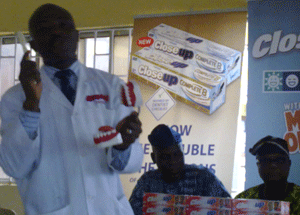
In the views of a professional Dentists from the Nigerian Dental Association (NDA), Dr. Olufemi Orebanjo, during an Oral Care Social Mission cum Brush Twice Daily Programme organised by Unilever Nigeria Plc in collaboration with NDA at the Ajeromi /Ifelodun Local Government Area of Lagos State last week, regretted that despite the fact that studies have shown that brushing twice a day could prevent against such life threatening diseases many Nigerians seem not to be embracing twice daily brushing.

Statistics available have shown that more than estimated three billion people do not brush twice a day.

In developing countries like Nigeria, where there is low awareness of oral hygiene and a poor healthcare infrastructure, 90 per cent of dental cavities remain untreated.

According to the World Health organisation, (WHO) even in developed countries only 5 to 10 per cent of public health expenditure relates to oral health.

Speaking further, Orebanjo who also noted that poor oral health is preventable said twice brushing can reduce tooth decay.

Read More

Tuesday, July 26, 2011

Tooth and Teeth Disease

Tooth
The History and Causes of Tooth and Teeth Disease:

Essentially, the definition of tooth and teeth disease is anything which causes teeth to be malformed or suffer increasing damage in some way, over a period of time. So tooth and teeth diseases can be caused by genes or the environment. The key to the definition is that it is a process that occurs over time.

Tooth and teeth disease has been around since ancient times. From autopsies of Egyptian mummies, we know that some of the ancient Egyptians died agonizing slow deaths because of uncontrolled tooth disease / decay. Some mummies had all their teeth and jaws infected by tooth disease.

In the 1700's and 1800's we know from published cartoons that toothache was around and was treated often by blacksmiths and, often in public, even on public stages in front of large audiences.

In the late 1800's early 1900's, America was known as having the highest rates of tooth and teeth disease anywhere in the world. The cause of the high rate of tooth and teeth disease was attributed to the highly refined foods that Americans were eating.

The refined foods introduced higher concentrations of substances into the food supply, especially acidic types, which eat away / erode the tooth enamel.

It is clear, that even in the 1800's, the importance of diet in causing tooth and teeth diseases was well known.

This knowledge of tooth and teeth diseases continues to be verified to this day. When soft drinks became widely available, tooth disease increased quite markedly. Soft drink contains both sugar and acid which can quickly breakthrough the enamel of teeth, via causing plaque and acid erosion, allowing disease to enter the teeth.

Read More

Tuesday, April 26, 2011

Brushing Tips

Dental Health
The modified Bass technique (below) is among the most popular for adults. Parents should supervise their children's brushing until age 9 or 10. Here are a few general pointers about brushing.

Brush at least twice a day.
One of those times should be just before you go to bed. When you sleep, your mouth gets drier. This makes it easier for acids from bacteria to attack your teeth. Also try to brush in the morning, either before or after breakfast. After breakfast is better. That way, bits of food are removed. But if you eat in your car or at work, or skip breakfast, brush first thing in the morning. This will get rid of the plaque that built up overnight.


Brush no more than three times a day.
Brushing after lunch will give you a good midday cleaning. But brushing too often can damage your gums.


Brush lightly. Brushing too hard can damage your gums. It can cause them to recede (move away from the teeth). Plaque attaches to teeth like jam sticks to a spoon. It can't be totally removed by rinsing, but a light brushing will do the trick. Once plaque has hardened into calculus (tartar), brushing can't remove it. If you think you might brush too hard, hold your toothbrush the same way you hold a pen. This encourages a lighter stroke.


Brush for at least two minutes.
Set a timer if you have to, but don't skimp on brushing time. Two minutes is the minimum time you need to clean all of your teeth. Many people brush for the length of a song on the radio. That acts as a good reminder to brush each tooth thoroughly.


Have a standard routine for brushing.
Try to brush your teeth in the same order every day. This can help you cover every area of your mouth. If you do this routinely, it will become second nature. For example, you can brush the outer sides of your teeth from left to right across the top, then move to the inside and brush right to left. Then brush your chewing surfaces, too, from left to right. Repeat the pattern for your lower teeth.

Read More

Toothless chemical law is toxic to the public's health

Toxic Chemicals
The American Academy of Pediatrics' recent statement urging the federal government to do more to protect pregnant women and children from toxic chemicals is getting lots of attention in the media. The more meaningful question is whether the safety push will get the attention it deserves from Uncle Sam.

The pediatric group's request is hardly outrageous. It asks that Congress make the archaic Toxic Substances Control Act live up to its original mission and protect Americans from potentially poisonous substances in our products.

As it stands now, the act is a joke. It hasn't been revised in any meaningful way since first passing congressional muster in 1976. Since then, tens of thousands of chemicals have been introduced into the environment through new products, and we know little to nothing about whether they are making us sick.

Read More
The act is our best chance of finding out, and making the manufacturing industry accountable, but that would require adding some teeth to a law this is mostly gums.

Out of about 80,000 chemicals being used by a host of manufacturers, the law has led to regulation on just five chemicals or chemical classes during the past 35 years. Some argue that the Toxic Substances Control Act is such a weakling that it couldn't even be used to ban cancer-causing asbestos.

Under the act, manufacturers are not required to test whether chemicals are safe before putting them in the products we use. That's a scary proposition given the increasing number of studies raising concerns about the behavioral, developmental and other health risks that may be associated with some chemicals, such as the ubiquitous bisphenol-A, or BPA, and phthalates found in many plastics.

The federal government isn't ignorant of these concerns. In January 2010, the U.S. Food and Drug Administration announced that, because of the potential human health impacts of BPA, it would study ways to reduce exposure to the compound in food packaging. Two months later, the U.S. Environmental Protection Agency added BPA to its list of "chemicals of concern" and announced a "BPA action plan" that included requiring manufacturers to provide test data to help determine the potential impacts of BPA.

Friday, April 15, 2011

“Smile Survey” shows oral health successes

Smile
OLYMPIA ¾ The tooth decay rate for Washington children in 2010 remains as high as it was in 2005, newly tabulated results from the 2010 “Smile Survey” show. Untreated decay is at an all-time low.

The rates for sealants, an important preventive measure to prevent tooth decay, have remained the same overall since 2005. A significant increase in sealants was noted among children from racial and ethnic minorities from 2005 to 2010.

The Smile Survey (doh.wa.gov/cfh/oralhealth/docs/datapubs/SmileSurvey.pdf) is conducted every five years to monitor children’s oral health. Dental disease can lead to pain, infection, growth and development problems, and poor school performance.

“This is a preventable problem that can affect a child’s entire life,” said Washington State Health Officer Dr. Maxine Hayes, a pediatrician. “The survey shows successes, and remaining needs.”

During the 2009-2010 academic year, low-income preschoolers from 48 Head Start-Early Childhood Education and Assistance Program sites, along with kindergarteners and third-graders from 53 public elementary schools, were surveyed. Results from about 7,500 children show Washington has had some success in children’s oral health – but some challenges remain:

· Children from low-income families were more likely to have more decay, rampant decay, and treatment needs than those from families with higher incomes. Following income, Hispanic ethnicity or being from a family that spoke a language other than English at home (especially Spanish) were the next strongest predictors for having more decay, rampant decay, and treatment needs.

· Rates of untreated decay are at their lowest ever for Head Start-ECEAP preschoolers and public school third-graders in 2010.

· Sealant rates didn’t change overall from 2005 to 2010, but rose significantly for children from racial and ethnic minority groups, especially those speaking Spanish at home.

· Compared to the national Healthy People 2020 Objectives, Washington still has statistically significantly higher rates of decay for preschoolers and third-graders. Washington successfully met national objectives for untreated decay and sealant rates.

Read More